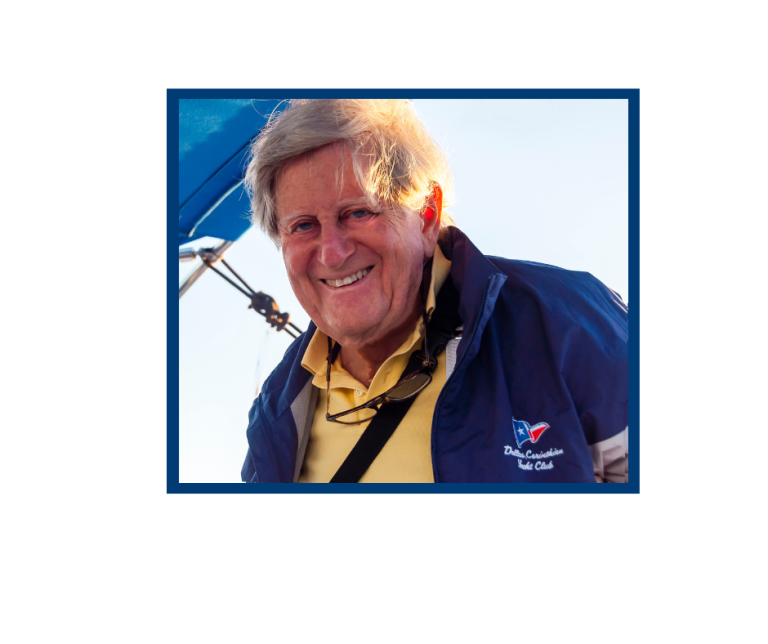
JAY HOPPENSTEIN, MD
BIO

I began sailing in the late 1950s when a friend of mine acquired a Sunfish.  We sailed together on this wooden boat which had an entirely flat deck without a “cockpit”.  The boat’s single sail was lanteen rigged.
 
The boat became severely worn and weathered with a damaged mast.  When my friend upgraded to a Rhodes 19, I purchased the almost derelict Sunfish for $1!  I spent a summer replacing the missing hardware, sanding the hull and painting it.  In the early 1960s, I “taught” myself how to sail it, reasonably well.
 
When I left Dallas for Minneapolis for my Surgical Internship, I sold the boat to a family for their daughter.  While in Minesota, I sailed a few times during the summer on a scow at the invitation of another surgery resident.
 
My Surgical residency took me to Morgantown, West Virginia.  There I purchased a German made, collapsible, Klepper which was a sloop and could be packed into 5 bags that would fit into the back seat of my Corvair.  It could be assembled in about 40 minutes without using any tools.  I sailed this boat with my wife as crew until about 1971.
 
I began crewing for a doctor colleague in a Lido 14 on White Rock Lake in Dallas because his wife was pregnant.  He was an excellent sailor from whom I learned a lot about racing sailboats.  Together we won most, if not all, of the races conducted on Sundays.  I liked the boat and the fleet so much that I purchased a used one that my wife, Carole Ann, acting as crew, sailed and raced for 10 years.
 
Eventually, I worked my way up to becoming one of the winning skippers in our Lido fleet.  To enhance my skills as a skipper, I acquired a Butterfly, a single-handed scow, that I raced all year on a Saturdays even in frigid weather.  Many other skippers of all of the fleets sailing on White Rock did the same.
 
When Carole Ann became interested in other activities, my oldest son, Jeffrey, crewed for me for about another 10 years.  Unfortunately, the Lido fleet gradually diminished until the racing was no longer competitive.  The Lido was sold and I acquired a Catalina 27, tall rig, which was on Lake Lewisville.
 
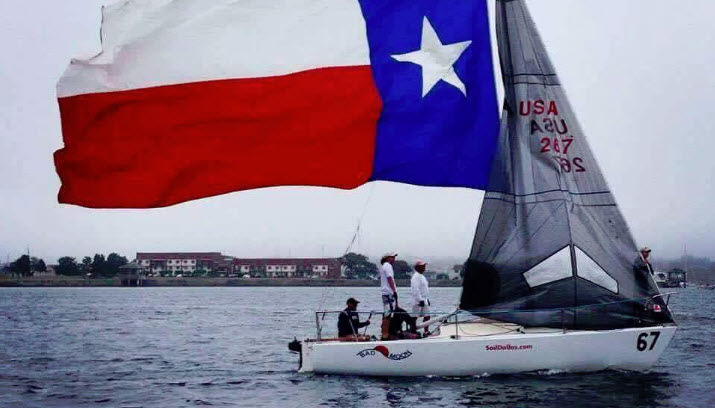
There I learned to sail and race a keel bottomed boat and fly a spinnaker.  I kept the boat at Eagle Point Marina but sailed it across the lake for DCYC regattas.  DCYC had a few other Catalina 27s.  I than joined DCYC and moved my Catalina 27, there.  
 
Everything that I did to make my boat go faster did not work.  Eventually, I learned that my Catalina, which had an inboard gasoline engine and a cockpit wheel for steering, was heavier that my older, competitors’ boats and mine would never be able to beat them.
 
I first saw J105s race while I was crewing on a Hunter owned by my cousin in Galveston Bay during an Elyssa regatta.  These J boats were beautiful and were fast.  I met Bob Sittel, the J boat Southwest dealer, who brokered the sale of a 1996 J Boat birthed on Lake Texoma to me.  I named her, Cyrano.
 
When brought to DCYC everyone wanted to crew on Cyrano.  It was stable in all wind conditions, had a PHRF of 78, had a comfortable cockpit and was fast.  Together with my crew, we won a lot of races.  I love this boat.  I sometimes anchor in a quiet cove over a weekend with my family and, more often, lately, when it’s not too hot, spend the night aboard, myself.
 
I have taught many new sailors the skills of sailing using Cyrano as the training vessel.  Many of my students have become excellent sailors, always in demand, sailing aboard blue water yachts in famous offshore races.
 
I, too, have sailed offshore, in the BVIs several times, in the Greek Islands, in New Zeeland, in Bermuda and from the US Virgin Islands to the Chesapeake Bay.
 

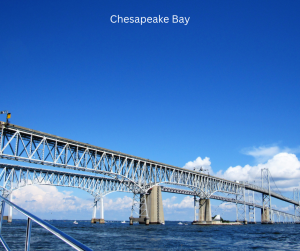
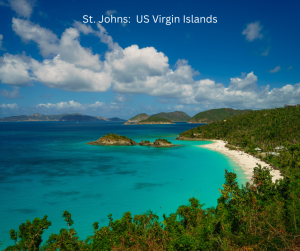
From St. Johns in the US Virgin Islands to the Chesapeake Bay, USA  
by Jay Hoppenstein, MD ©
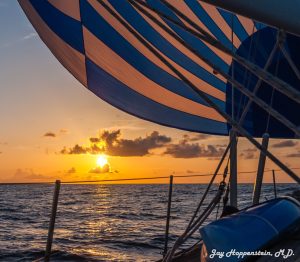
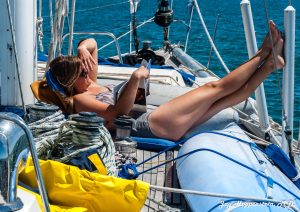
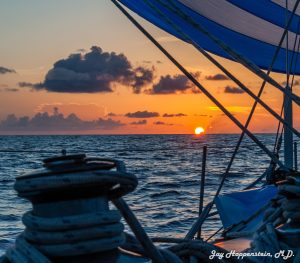
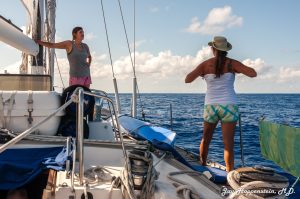
I cannot forget the pleasant and often exhilarating motion of Valkyrie that was my “home” over the last two weeks in 2016.  As is often the case that sense of motion carries forward after leaving the water, even if that time sailing were only for an afternoon.  For me it has been a reminder of the exceptional time spent heading north from St. John into an ocean full of wonder.

The routine ashore differs significantly from that aboard a cruising sailing craft.  Certainly, there is a defined schedule of watches and a repetitive process required to oversee and maintain a sailboat; however, the adventure of sailing across an ocean is full of unexpected challenges and pleasures: fish on a line, dolphins catching a ride on the bow wave, flying fish zooming a foot above the water, warmth of the Gulf Stream, silent, mammoth commercial vessels crossing our path and heading to their foreign ports, swells that surpass the height of the cockpit, seas so still that the star’s reflections are as brilliant on the water as the stars are in the heavens and US Naval ships warning us to stay clear.  No day is like the day preceding nor the one to follow.

Sometimes, the appreciation of an experience is apparent, immediately; other times; it blooms slowly with reflection. For me, the voyages from St John to the Deltaville Boatyard deep into the complex shoreline of the Chesapeake Bay manifest both of these realizations. This experience can be shared with others who have not been to sea only to a limited degree, neither how eloquent is the teller-of-the-tale, nor how receptive are the listeners. There exists for those who have sailed with mates across a sea, in the black of night, a bond of trust and respect that is uniquely personal. Such experiences become woven into the fabric of anyone who takes the step from the security of the shore into the microcosm of a vessel, trusting her seaworthiness, her skipper and crewmates to safely complete the voyage. For this I am thankful and grateful.

THE SAILOR

 BY JAY HOPPENSTEIN, MD © 
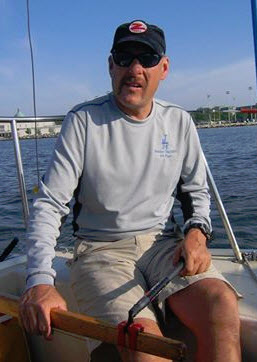
Adapted from Kenny Roger’s song, The Gambler
Pursuit Race August 8, 2009
 
On a perfect summer’s evenin’, on a course bound for nowhere,
We met up with three racers, all eager to compete.
We took our place a-waitin’ our timed turn to start the Pursuitin’
Till the watch countdowned our sequence, and we began the beat.
 
Peters started first in Bon vi Vant his beauty,
And Kelly led the J boats, was next to cross the line,
Sailing Faded Lady with Scoots right behind him.
In appreciation of his winnin’, Kelly shared with us his mind.
 
So we flaked our sails, stowed our gear and put our boats away.
Then he asked us for a beer and took a deep swallow.
And a crowd gathered round, as he took his place among them,
Said, “If you’re gonna race against us, these rules you gotta follow.”
 
“Now every sailor knows, that the secret to always winnin’
Is knowin’ when to bear away and knowin’ when to pinch.
You never reach the layline early, even when you’re leadin’ 
There’s no use in celebratin’ early, no race is a cinch.”
 
So when he finished speakin’, he left us there a standin’.
Walked off into the darkness leaving us alone.
We might see him tomorrow out there upon the water,
But in his remarks we found a pearl that brightly shown.
 
You got to know when to luff ‘em, know when to bluff ‘em,
Know when to bear away, know when to run.
Never count your place, when-becalmed in a drifter,
There’ll be time enough for celebratin’ when the racin’s done.